
Jackson County Criminal Court Cases
Jackson County criminal court cases do not all begin and end in one division. Circuit Court in the 38th Judicial Circuit tries felonies, connected offenses, and appeals. District Court hears misdemeanors, state traffic matters, and the early stages of felony cases. A felony complaint may first appear in District Court for an initial appearance or preliminary hearing, then move to Circuit Court after indictment. The Jackson County Circuit Clerk is the official record keeper for both divisions.
Municipal courts keep ordinance and in-city matters within their own jurisdiction. That split matters when a Jackson County case search seems blank. A city charge may remain with Scottsboro, Bridgeport, Stevenson, or another municipal court rather than the county clerk. State charges from the same event can still appear in District or Circuit Court. Searchers should identify the filing court before deciding that no record exists.
Follow Jackson County Charges
The charge level points to the likely court, though it does not settle the result. Alabama classifies felonies from Class A through Class D. Jackson County Circuit Court handles felony trials. District or municipal court handles a misdemeanor when jurisdiction fits. District Court also conducts preliminary felony work, so the same event may leave entries at more than one level.
| Record clue | Likely Jackson County court | What to verify |
|---|---|---|
| Felony indictment | Circuit Court | Charge, plea, judgment, and sentence |
| Felony complaint | District Court first | Preliminary stage and later Circuit case |
| State misdemeanor | District Court | Filed count and charge-level disposition |
| City ordinance matter | Municipal court | City file, payment, and final outcome |
This court split is also why a booking charge is not enough. The prosecutor may amend the count, and a grand jury may return a different indictment or no-bill the matter. The docket and judgment supply the later court history.
Searching Jackson County Case Records
Start with the free county docket when a hearing date is the main need. Use the paid statewide service when broader case detail is needed, then contact the clerk for an official copy. These channels are not equal. The county view is a calendar, while the clerk can search the case file and certify a disposition.
- Open the Jackson County docket list. Confirm that county code 39 is shown.
- Choose one of the setting dates. Enter a last name when known, or leave it blank to display the full setting.
- Read the generated PDF as a court calendar. Note the case number, party, court, and setting information needed for follow-up.
- Use Just One Look for paid, account-based access to one Alabama trial court case at a time.
- Call or visit the clerk's Criminal Division for a case-action summary, judgment, sentence, or certified disposition.
The official Jackson docket screen exposes only the controls documented below. It does not provide the broader name, birth date, and case-type filters found on some commercial systems.
| Field Label | Type | Required | Notes |
|---|---|---|---|
| County | Fixed label | Yes | 39 identifies Jackson County |
| Setting Date | Dropdown | Yes | Five displayed dates that roll with the current day |
| Last Name | Text | No | Blank returns the full setting; wildcard behavior is unstated |
| Search/display | Action | Not applicable | Builds or displays a PDF docket |
Jackson County Docket Calendar
The free Jackson County docket list is useful for a known setting date. It is not a full criminal-history search or a certified disposition index. Its own warning says that some cases may not appear electronically and directs uncertain users to the clerk. A blank search can mean the case is not set on one of the displayed dates, uses another surname, sits in a municipal court, or has not reached the electronic list.
The official docket screen shows what the county-coded search looks like. The Jackson County docket source supplies the context for this view.
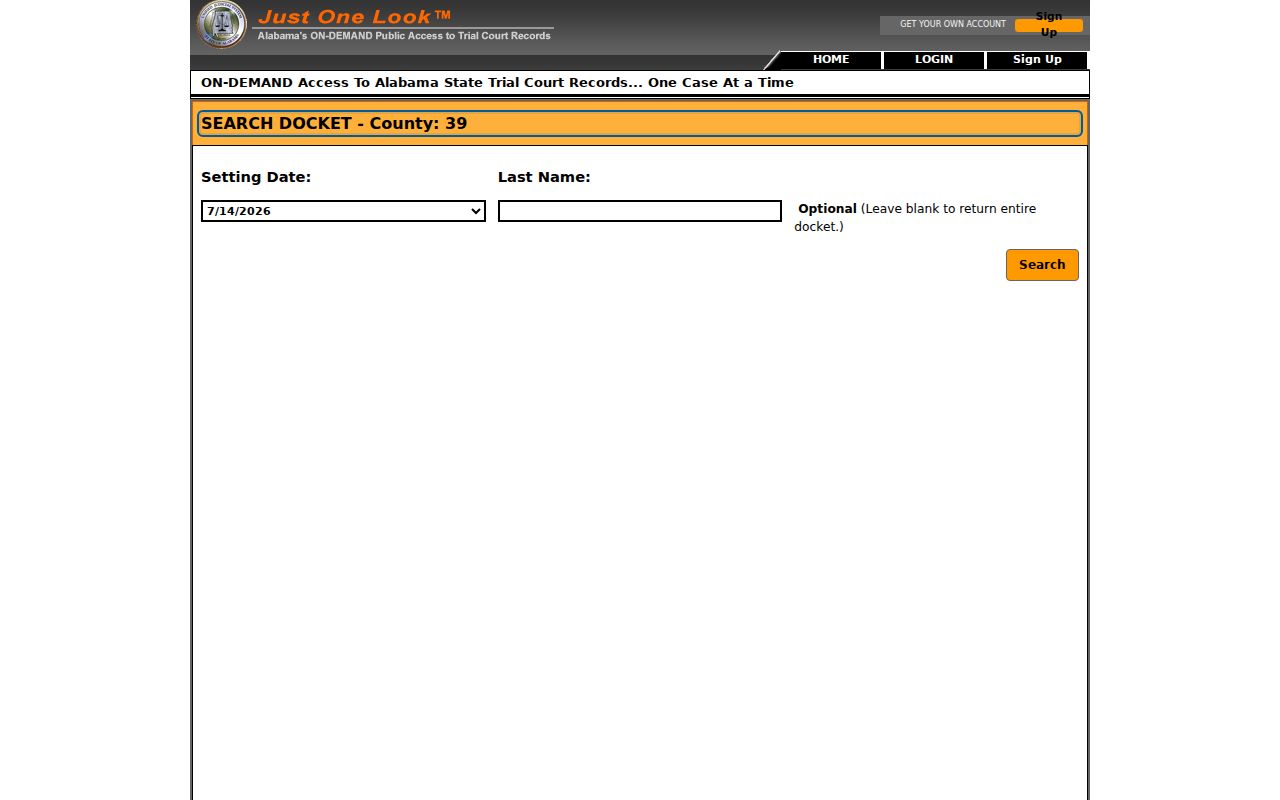
The image shows why the date and surname are leads, not proof of a complete Jackson County file. Keep the case number from the PDF and ask the clerk to check both District and Circuit divisions.
Inside a Jackson County Case File
A Jackson County criminal case file is a case-specific set of pleadings, docket events, rulings, financial entries, and outcome records. It is different from the jail's custody snapshot and ALEA's fingerprint-linked chronology. The most useful item depends on the question. A case-action summary traces events, while a certified disposition or judgment states the formal result.
| Case Number & Court | Identifies the file, division, and court that owns the record. |
|---|---|
| Charging Document | Shows the complaint, indictment, or other filed accusation and cited law. |
| Docket Entries | Lists filings, settings, motions, warrants, rulings, and other court actions in order. |
| Hearing Dates | Shows arraignment, motion, plea, trial, or sentencing settings when recorded. |
| Disposition & Judgment | States the result for each charge, such as conviction, acquittal, dismissal, or nolle prosequi. |
| Sentence & Conditions | Records the court-ordered term, costs, restitution, supervision, or other conditions. |
Read each count on its own. A broad status such as “closed” does not by itself mean conviction, and an arrest charge may differ from the final count.
Jackson County Cases in Just One Look
Just One Look is Alabama's on-demand trial court service. It is account-based and paid, and it presents records one case at a time. State documentation describes categories that may include basic case data, parties, court actions, rulings, status, settings, financial history, a case-action summary, and available images or attachments. The accessible landing page does not expose a stable full filter list or checkout total, so no unsupported price or search field should be assumed.
The official Just One Look landing page illustrates the statewide access point used for Jackson County court cases.
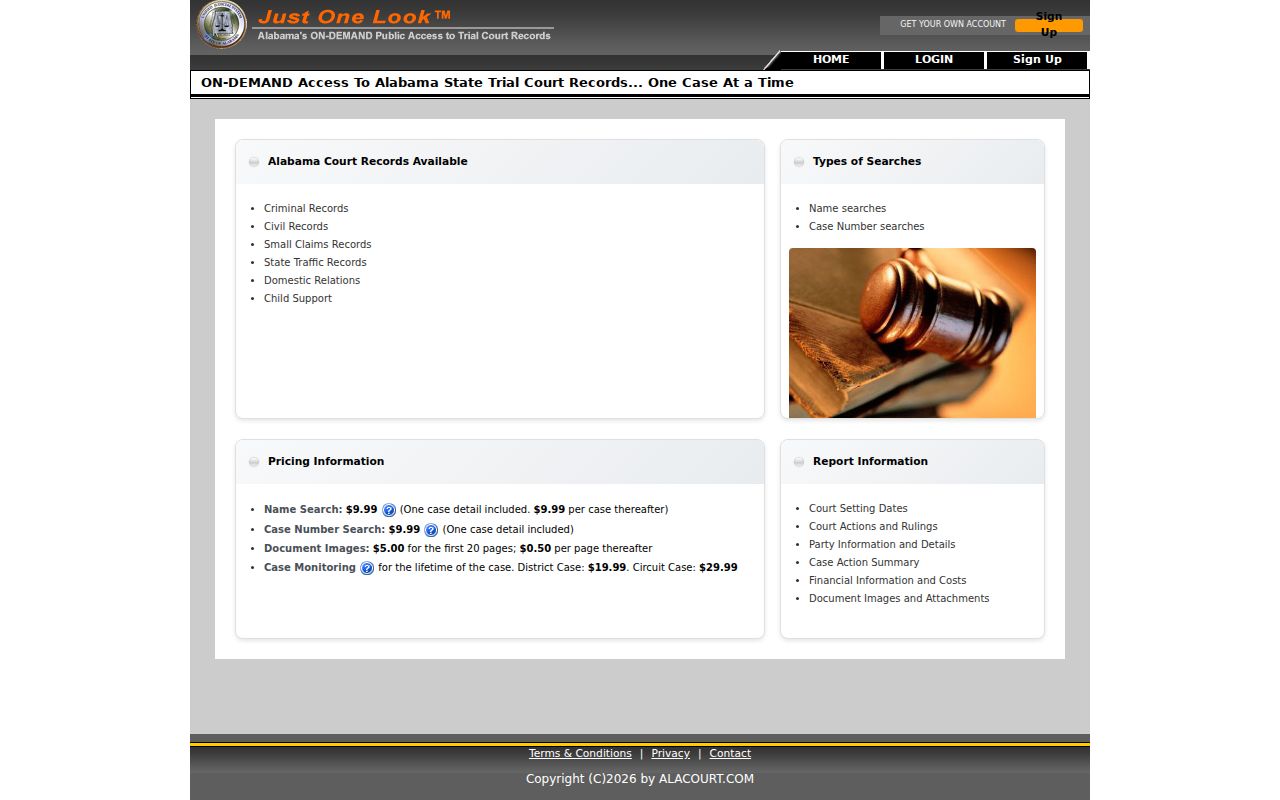
Use the paid view for remote detail, but use the Circuit Clerk when a certified copy, an omitted case, or a clear charge-level outcome is required.
How a Criminal Case Moves
A Jackson County criminal case can begin with a complaint and warrant or with a warrantless arrest. Booking follows, but the court file then takes its own path. Alabama procedure calls for an initial appearance without undue delay. A felony can pass through a District Court preliminary stage, if timely demanded, before a grand jury and Circuit Court. A misdemeanor generally stays in District Court, while a municipal matter follows the city track.
Case flow: Charges Filed → Arraignment → Pretrial → Plea or Trial → Disposition → Sentencing
After judgment, the Jackson County file may also show an appeal, incarceration, costs, or community supervision. The Jackson County arrest lookup can help identify the booking event, but only the court file supplies the filed charge and outcome.
Read Jackson County Dispositions
Disposition is the result of a Jackson County charge, not merely the point when a case stops appearing on a setting list. A conviction follows a plea or verdict and judgment. An acquittal is a not-guilty result. A dismissal ends the count without conviction. Nolle prosequi means the prosecutor formally chose not to continue, while a no-bill means the grand jury declined to indict.
- Pending
- The court has not entered a final charge-level result.
- Nolle prosequi
- The prosecutor formally ended the prosecution of that count.
- No-bill
- The grand jury did not return an indictment on the proposed felony charge.
- Disposition
- The recorded outcome for a specific charge.
- Sentence
- The consequence ordered after a conviction and judgment.
When an ALEA self-review shows an outcome that differs from Jackson County court records, obtain a certified disposition from the clerk and use ALEA's challenge route. The clerk's record is the source for the court result.
Case Record Access & Restrictions
Alabama's public-record rule does not make every part of every Jackson County case file open. The Alabama Open Records Act resource manual explains the right of Alabama citizens to inspect public writings unless another law creates an exception. Juvenile and Youthful Offender files receive special protection. Victim and minor identities, personal identifiers, sealed material, and protected investigative details may be withheld or redacted.
An online omission does not prove the Jackson County file is sealed or nonexistent. Contact the Criminal Division at 102 East Laurel Street, Scottsboro, AL 35768, or 256-574-9320. The Jackson County Warrant Magistrate and Criminal Division counter is on the second floor and publishes hours of 8:00 a.m. to 4:00 p.m. Ask for both Circuit and District searches, give an approximate year and any known aliases, and request the current copy or certification price because no official local criminal-copy fee sheet was located.
Note: A certified disposition is the strongest Jackson County record for proving how a filed criminal charge ended.
Jackson County Warrant Case Files
Warrant access has a local boundary that can explain a missing Jackson County criminal case record. The clerk states that an arrest warrant is not public until it is served. Someone who suspects an active county warrant must use the official in-person sheriff route at the courthouse. The sheriff's Most Wanted feature is only a selected enforcement publication. It cannot prove that a person has no warrant.
After service, the Jackson County warrant may leave a trail in a booking or court docket. The Warrant Magistrate in the second-floor Criminal Division handles felonies anywhere in Jackson County, misdemeanors outside municipal limits, Jackson traffic offenses, and qualifying worthless-check matters. In-city misdemeanor warrants belong with the relevant municipal court. That split can place related records with more than one custodian.
The Jackson County warrant office rules also describe how a new misdemeanor warrant request begins. The person first makes a police or sheriff report, takes the report to the clerk, completes a deposition, and testifies under oath before a neutral magistrate. The published process requires no appointment or fee. Felony complaints require investigation by the agency with jurisdiction before the warrant stage proceeds.