
Sex Offender Checks in Jackson County
The official starting point is the Alabama Law Enforcement Agency Sex Offender Registry. ALEA maintains the public state layer, and its Sex Offender Registry Unit receives registration data, photographs, and fingerprints from local agencies. In Jackson County, the Jackson County Sheriff's Office links residents to that official search and serves as the local law-enforcement contact for registration and address-compliance questions. The sheriff does not publish a separate county-only registry database. A county filter in the ALEA-linked system is the right local view.
Start with the facts you know. A name is useful when checking one person, while a Jackson County, city, ZIP, address, or map search is better for community awareness. Read the full profile instead of relying on the result list. Name variants, address history, registering agency, qualifying offense, and compliance status can change the meaning of a match. The registry updates from local reports, but no public system can promise that each fact is current at the moment of a search.
Jackson Sex Offender Updates Reach ALEA
Registration begins locally. Jackson County law enforcement records the required report, verifies information within its authority, and sends the data to ALEA. The state agency says its public registry updates daily in real time based on reports from registering agencies. That flow matters because the public profile is not created by a separate private database. It reflects facts that move from the local registration office into the state system.
The ALEA registry information page also explains the update and verification cycle. The successful manifest capture from that official source shows where Jackson County searchers can review current registry guidance.
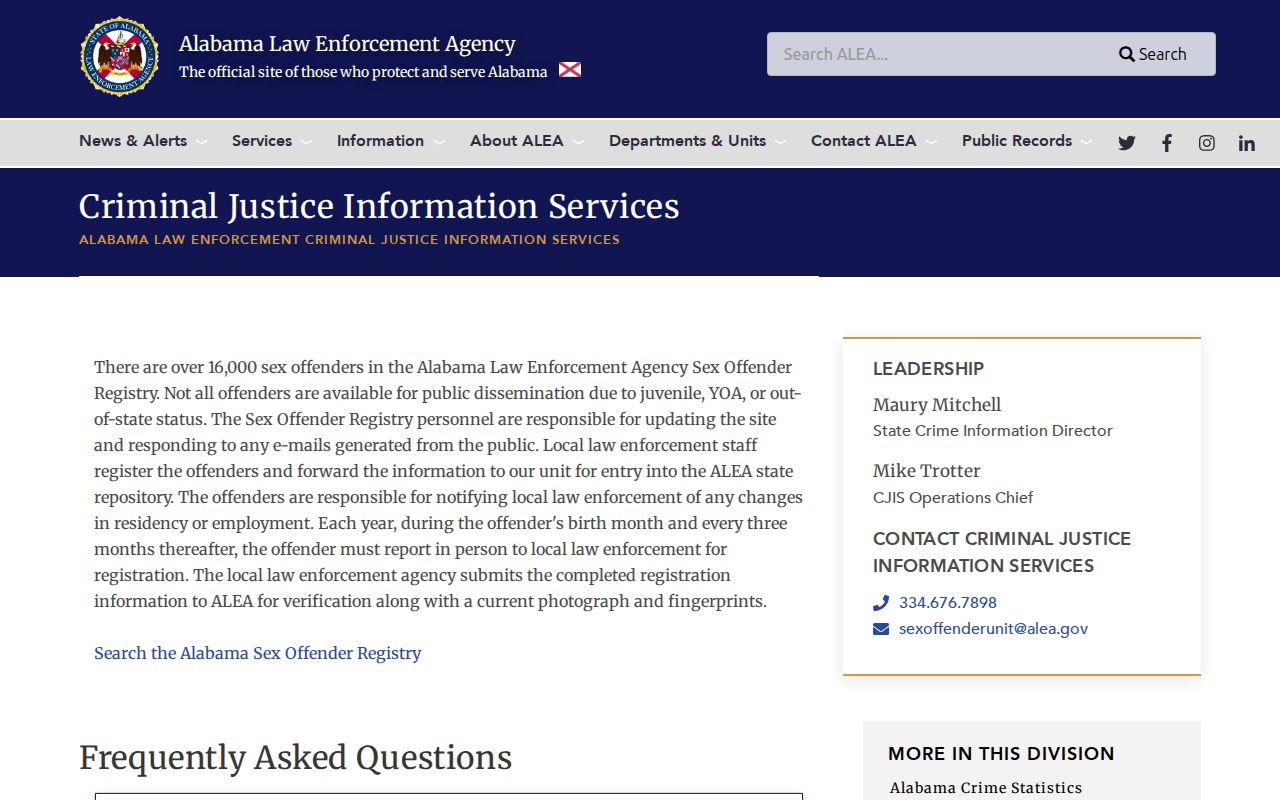
This official guidance helps explain why a recent local change may take time to appear and why the registering agency remains the best place to verify an address concern.
How to Search the ALEA Registry
ALEA links to the public OffenderWatch search used for Alabama registry records. The interface supports both person-based and place-based searches. It can return map or list results for Jackson County, but the live radius choices may change. Use the options displayed by the official interface rather than assuming a fixed distance. The search is free, and its conditions of use stress verification and lawful conduct.
- Open the ALEA information page, follow its official public-registry link, and read the conditions of use before continuing.
- Choose a name search or enter an address, city, ZIP code, or Jackson County location for a geographic search.
- Review the map or list. Compare aliases and physical details carefully so a similar name does not become a false match.
- Open the complete profile. Check the registering agency, address, offense details, status, and any displayed update information.
| Field Label | Type | Required | Notes |
|---|---|---|---|
| Surname or name | Text | No | Use for a known person; compare aliases and physical traits. |
| Address | Text | No | Starts a geographic search around a street location. |
| City or ZIP | Text/select | No | Narrows the map or list to a community or postal area. |
| County | Select | No | Choose Jackson for a countywide result set. |
| Radius or map | Map/control | No | Use the distance options shown on the live interface. |
Why Jackson Registry Results May Be Missing
A blank Jackson County sex offender search is not a safety clearance. Alabama publishes records under the offense and status rules in Title 15, Chapter 20A. ALEA explains that only offenses listed in Ala. Code § 15-20A-5 are posted through the standard public process. A first conviction for sexual misconduct or indecent exposure may carry registration and verification duties without the same public display. Juvenile adjudications are generally withheld unless the required risk finding supports publication.
Youthful-offender rules also include age and offense limits. Some out-of-state, federal, military, or tribal convictions require due process before Alabama posts them. A listed address may be old if a person failed to comply, while a recent move may still be moving through the local reporting chain. Check the profile status and registering agency, then call law enforcement when a material fact seems wrong.
Note: Absence from the Jackson County registry does not establish that no confidential, nonpublic, or not-yet-posted record exists.
Inside a Registry Profile
A full registry profile is more useful than a pin on a map. It combines identity details, public address information, registration status, the registering agency, and qualifying-case facts that Alabama law permits ALEA to release. Read each field in context. An offense label and conviction date describe the qualifying record, while compliance status addresses registration duties. Neither field reports every event in a person's criminal history.
| Name and aliases | Current display name and other published names used to distinguish a match. |
|---|---|
| Photo and description | Current photograph plus gender, race, age, height, weight, hair and eye color, and published marks or tattoos. |
| Address and map | Registered location, map placement, and prior or secondary addresses when the profile displays them. |
| Offense details | Qualifying offense and statute, conviction date and jurisdiction, and victim-age category where public. |
| Other public facts | Vehicles and school or employer information when Alabama law makes those categories public. |
| Registration status | Compliance information and the Jackson County or other registering law-enforcement agency. |
Jackson Registry Data: Public and Protected
The public profile does not expose the whole registration file. ALEA and local law enforcement retain data used for identity and compliance work, including fingerprints and other protected identifiers. Social Security numbers, DNA material, medical data, and nonpublic investigative information do not become open merely because some profile categories appear online. Ala. Code § 15-20A-8 governs public release and helps explain why public detail differs by offender status.
That line protects both safety and accuracy. A searcher gets enough information to identify a profile and contact the correct agency, while sensitive source data stays with law enforcement. If a Jackson County profile conflicts with a fact you know, do not try to obtain the protected file. Save the public URL, note the field at issue, and report the concern through the sheriff or ALEA Registry Unit.
Alabama Registration Levels and Requirements
Alabama does not use a simple public Tier I, II, and III chart with automatic 10-year, 25-year, and lifetime terms. Its Sex Offender Registration and Community Notification Act ties duties and publication to the offense, age, adjudication type, and legal status. For adults subject to the full scheme, ALEA describes registration as generally lifelong. It also says reporting occurs during the birth month and every three months after that, along with prompt reporting of required changes.
| Alabama category | Public duration | Verification finding |
|---|---|---|
| Adult under full ASORCNA duties | Generally lifetime | Birth month and every three months thereafter |
| First sexual-misconduct or indecent-exposure registration-only case | Depends on the governing statute | Registration and verification apply; public posting differs |
| Juvenile sex offender | Risk-assessment dependent | High-risk findings can permit public dissemination |
| Youthful offender | Age and offense rules control | Publication and duties depend on statutory status |
NSOPW Expands Jackson Offender Searches
The National Sex Offender Public Website adds a cross-state layer. It searches participating jurisdictions through a U.S. Department of Justice gateway, which helps when a person has moved or when the likely state is not known. It does not replace the Alabama profile or Jackson County verification. State law still controls what Alabama publishes, and local law enforcement remains the source for an address-compliance concern.
The official NSOPW search page was also captured successfully for the Jackson County sex offender search manifest.
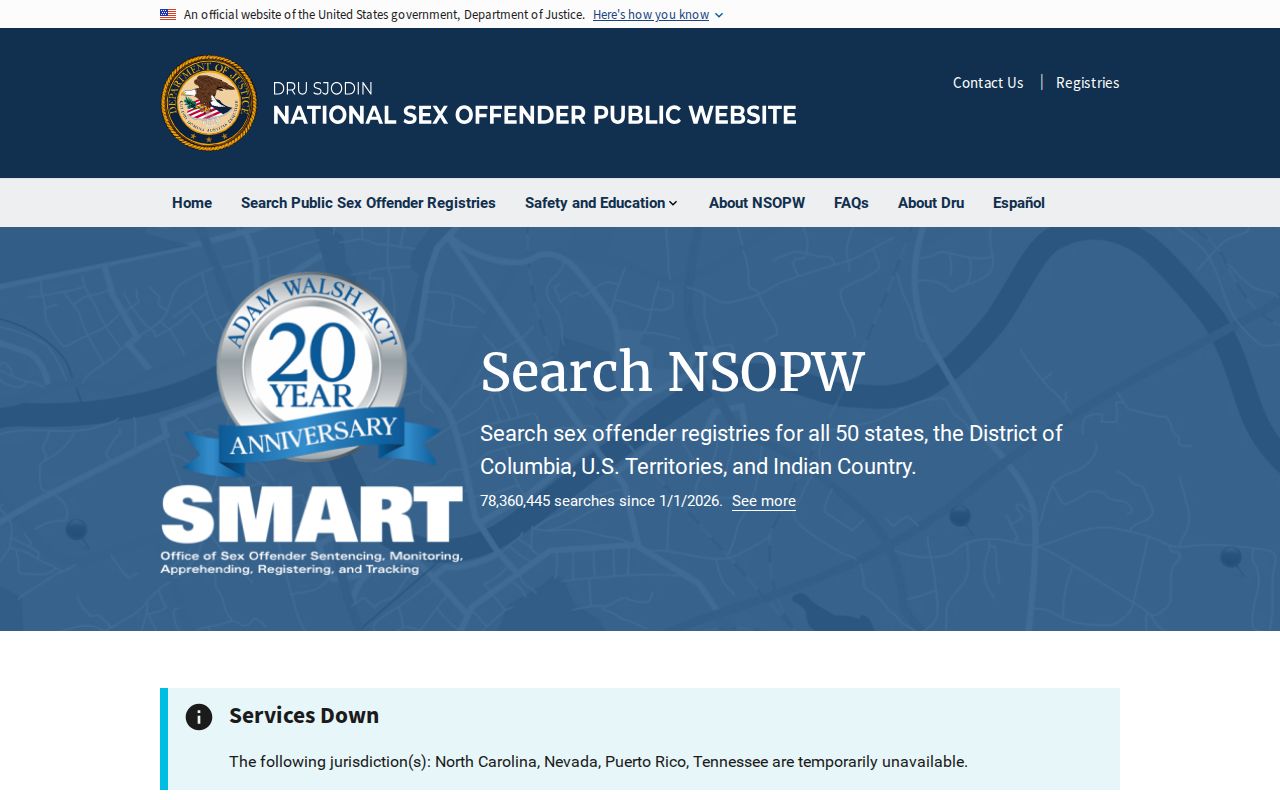
Use a national result to identify the source jurisdiction, then open that jurisdiction's official profile and confirm key facts with the named registering agency.
Reporting Wrong Jackson Registry Addresses
When a Jackson County address appears wrong, gather the profile URL, the listed address, and the specific reason for concern. Do not visit the address or contact the person shown. Call the Jackson County Sheriff's Office at 256-574-2610 for local registration or compliance routing. The sheriff's online contact form is for non-urgent messages and is not watched around the clock. Its official FAQ page supplies related office and records guidance. Emergencies go to 911.
ALEA's Sex Offender Registry Unit can also receive registry questions at 334-676-7898 or sexoffenderunit@alea.gov. Local agencies verify addresses and transmit corrections to ALEA, so a clear report is more useful than a public accusation. The goal is to send the discrepancy to the office that can lawfully check it.
Jackson County Sheriff's Office
First-floor counter
102 East Laurel Street
Scottsboro, AL 35768
256-574-2610
Administrative counter: 8:00 a.m. to 4:30 p.m., Monday through Friday.
Community Notification and Lawful Use
Registry information supports personal, family, and neighborhood safety. Community notification is tied to Alabama law and the timing of a person's move or status change. ALEA notes that someone already living at an address before a neighbor arrives may not trigger the same new-arrival notice. A lack of notice therefore does not erase the need to check the official system when current awareness matters.
Residency and loitering rules are fact-specific. ALEA's FAQ describes a 500-foot loitering rule for specified offenders near certain schools, child-care sites, playgrounds, parks, athletic fields, and businesses that mainly serve minors. That is not a universal residence-radius rule. Questions about a specific Jackson County location belong with law enforcement or qualified legal counsel.
Misuse can be a crime: Ala. Code § 15-20A-8 governs public registry information. Do not use it to harass, intimidate, threaten, injure, or commit any crime against a listed person or household.
Report suspected noncompliance to the Jackson County Sheriff's Office or ALEA. Never confront a person based on a profile, and verify the record with the registering agency before relying on it.